Templates · React Native templates · Education · Leaf
Leaf React Native template: e-books and reading app in Expo
Leaf is an e-books and reading app design in a Minimal style, and its React Native download is a working Expo project: all 25 screens as routes, linked the way the prototype is, with the palette in one colours file. A complete e-book and reading app: welcome, taste picker and sign in, a home that picks up where you left off, a library of covers with progress, a serif reader with its menu, display sheet, contents, highlights, dictionary, notebook and notes, narration with a synced page, the store, search, a book page with checkout and a purchased screen, an author page, reading stats, a membership plan, notifications, profile and settings. Paper white and pine green with an apricot ribbon.
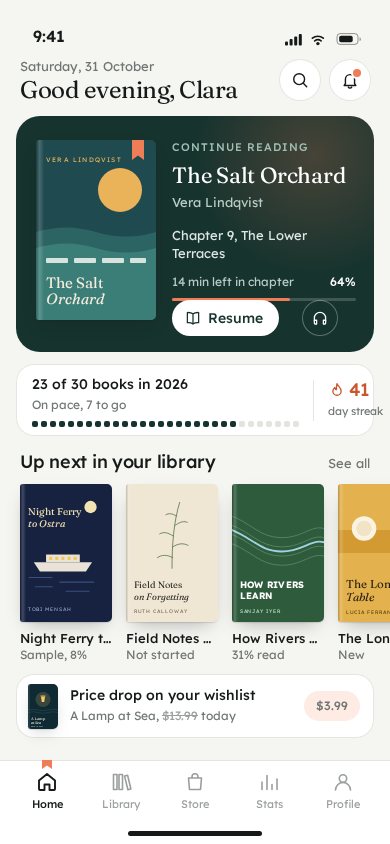
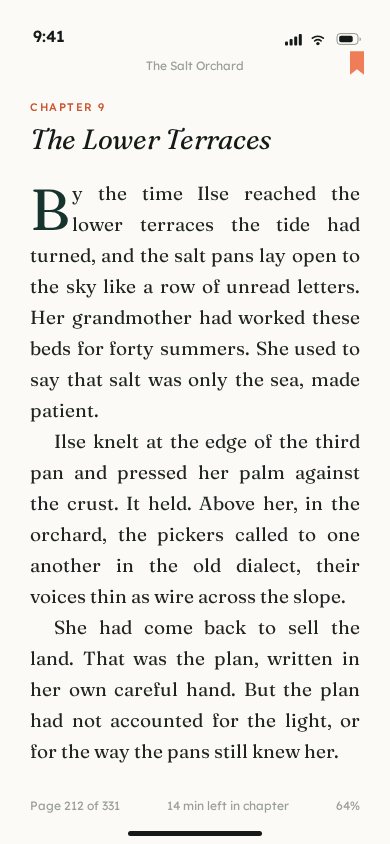
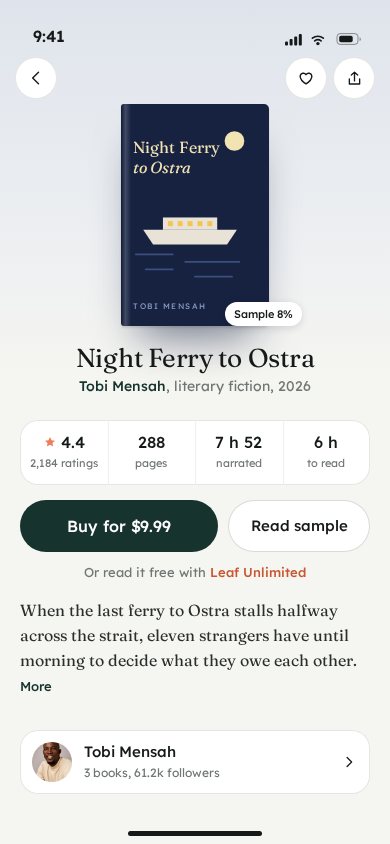
25 screens · Minimal · Light · Education
The Expo project
An Expo Router project on Expo SDK 58, in TypeScript. Every file name below comes from a screen in Leaf:
leaf/  # The project root
  src/
    app/  # Expo Router: one file per route
      _layout.tsx  # The stack navigator, with the fonts loaded
      index.tsx  # Opens on Welcome
      welcome.tsx  # Welcome (Onboarding)
      your-taste.tsx  # Your taste (Onboarding)
      sign-in.tsx  # Sign in (Sign in)
      home.tsx  # Home (Home)
      library.tsx  # Library (List)
      reader.tsx  # Reader (Media)
      reader-menu.tsx  # Reader menu (Media)
      display.tsx  # Display (Settings)
      contents.tsx  # Contents (List)
      highlight.tsx  # Highlight (Media)
      dictionary.tsx  # Dictionary (Detail)
      notebook.tsx  # Notebook (List)
      new-note.tsx  # New note (Form)
      listen.tsx  # Listen (Media)
      store.tsx  # Store (Search)
      search.tsx  # Search (Search)
      book.tsx  # Book (Detail)
      buy.tsx  # Buy (Checkout)
      purchased.tsx  # Purchased (Success)
      author.tsx  # Author (Profile)
      reading-stats.tsx  # Reading stats (Dashboard)
      leaf-unlimited.tsx  # Leaf Unlimited (Paywall)
      notifications.tsx  # Notifications (List)
      profile.tsx  # Profile (Profile)
      settings.tsx  # Settings (Settings)
    components/
      icons.tsx  # Every icon the screens use, as a component
    theme/
      colors.ts  # The palette by role
  assets/images/  # The photos
  app.json  # App name, scheme and splash
  package.json  # Expo SDK 58, Expo Router, fonts from @expo-google-fonts
  README.md  # How to run it and what is where
How to run it
- Get the template. Buy Leaf (files from $10, every format included), use a free download from a paid plan, or open it with a Template Pass.
- Download and install. Download the React Native zip, unpack it and run npm install in the folder. You need Node.js 20 or newer.
- Run it. Run npx expo start, then open it in Expo Go on your phone, or press i for the iOS simulator or a for the Android emulator.
- Make it yours. Change src/theme/colors.ts to recolour every screen at once, replace the sample content in each route, and add your data and backend.
npm install
npx expo start
What works on download
- Native components. Every screen is built from React Native views, text, images and SVG icons: no web views, no screenshots.
- Navigation. Wired between screens with Expo Router, following the links in the template's prototype: buttons and tabs go where they should.
- Theme. The palette lives in src/theme/colors.ts by role, and each screen keeps plain StyleSheet styles beside it: no styling library to set up.
What is yours to wire up
- Data. Lists, prices and profiles are static sample content from the template. Swap them for your own state or API calls.
- Backend. There is no backend, sign in or payments code. Forms and buttons are interface only, ready for your logic.
- Store setup. App icon, splash screen, bundle id and store listing are yours to set in app.json before you ship.
The 25 screens
| Screen | Screen type | Route file |
|---|---|---|
| Welcome | Onboarding | src/app/welcome.tsx |
| Your taste | Onboarding | src/app/your-taste.tsx |
| Sign in | Sign in | src/app/sign-in.tsx |
| Home | Home | src/app/home.tsx |
| Library | List | src/app/library.tsx |
| Reader | Media | src/app/reader.tsx |
| Reader menu | Media | src/app/reader-menu.tsx |
| Display | Settings | src/app/display.tsx |
| Contents | List | src/app/contents.tsx |
| Highlight | Media | src/app/highlight.tsx |
| Dictionary | Detail | src/app/dictionary.tsx |
| Notebook | List | src/app/notebook.tsx |
| New note | Form | src/app/new-note.tsx |
| Listen | Media | src/app/listen.tsx |
| Store | Search | src/app/store.tsx |
| Search | Search | src/app/search.tsx |
| Book | Detail | src/app/book.tsx |
| Buy | Checkout | src/app/buy.tsx |
| Purchased | Success | src/app/purchased.tsx |
| Author | Profile | src/app/author.tsx |
| Reading stats | Dashboard | src/app/reading-stats.tsx |
| Leaf Unlimited | Paywall | src/app/leaf-unlimited.tsx |
| Notifications | List | src/app/notifications.tsx |
| Profile | Profile | src/app/profile.tsx |
| Settings | Settings | src/app/settings.tsx |
The design
Quiet and bookish minimalism: a cool paper white page (#f5f5f1), white cards with a 1px #e5e6e1 hairline instead of shadows, and one deep pine (#17332e) panel or button per screen. The signature is an apricot (#ef7d57) ribbon bookmark: it hangs from the cover of the book you are reading, marks the active tab and the current chapter, and colours progress dots. Book covers are original flat paintings with a soft spine shade on the left edge, a 3px radius and a soft drop shadow. Titles of books and big headings are set in Fraunces, often with the second line in italic; the interface is Lexend. Reading pages are Fraunces 19px on 31px lines, with highlights in butter yellow (#fbe38e). Headings in Fraunces, body text in Lexend.
| Colour | Role |
|---|---|
| #f5f5f1 | background |
| #ffffff | surface |
| #151a19 | text |
| #6f7674 | text-muted |
| #ef7d57 | accent |
| #151a19 | accent-contrast |
| #17332e | secondary |
| #e5e6e1 | border |
| #d6452f | danger |
Get the files
Remixing Leaf is free. To get the template itself, the files are from $10, and one price unlocks every format:
- Figma. Every screen as editable layers: named frames, text, vectors and photos, with colour and text styles.
- React Native (Expo). An Expo Router project with every screen, the navigation between them, the theme and the icons.
- SwiftUI. An Xcode project for iOS 17 with a SwiftUI view per screen, fonts and assets.
- Flutter. A Flutter app with go_router, a widget per screen, fonts and assets.
- HTML. Each screen as a standalone HTML file with its fonts and photos, plus the design tokens as CSS and JSON.
Get the Leaf files · Leaf in Figma · Leaf in React Native · Every template with a Template Pass ($49 for a year)
Leaf in other formats
- Leaf Figma template
- Leaf in SwiftUI (in the same purchase)
- Leaf in Flutter (in the same purchase)
- See every Leaf screen and remix it free
More education React Native templates
- Gambit: Chess training
- Buzzer: Live trivia
- Homeroom: School, all on one page
- Parla: Language learning
- Recall: Flashcards and spaced repetition
- Numo: Kids maths game
- Education app templates
- All React Native templates
Questions people ask
- What do I need installed?
- Node.js 20 or newer and npm. To see it on a phone, install Expo Go; for simulators, Xcode (iOS, on a Mac) or Android Studio. No Expo account is needed to run it.
- Which Expo version is it?
- Expo SDK 58 (React Native 0.88, new architecture) with Expo Router, TypeScript throughout. Each screen is a route file in src/app, named after the screen.
- Does the same purchase include Figma and Swift?
- Yes. One price unlocks every format of Leaf: Figma, React Native (Expo), SwiftUI, Flutter and HTML. A Template Pass ($49 for a year) unlocks every template.
- Can I use the Leaf template commercially?
- Yes. You can build and ship commercial apps with it, for yourself or for clients, as many as you like. What you cannot do is resell or give away the template files themselves, as a template or a UI kit. The photos are free-licence stock used as placeholders: swap in your own before launch.
- Do I get updates?
- Yes, free. You buy the template, not a version: every download builds from the latest Leaf design, and your library flags a template that changed since you last downloaded it.
- Is a backend included?
- No. The download is the interface: screens, navigation, styles and assets. There is no server, database, sign in, payments or API code, and the content on each screen is static sample data for you to replace.
- What is the difference between buying and remixing?
- Remixing is free: you describe your own app and it is drawn in Leaf's design, in the DraftScreens studio. Buying gets you Leaf itself as files, from $10, in Figma, React Native (Expo), SwiftUI, Flutter and HTML.