Templates · React Native templates · Smart home · Tagged
Tagged React Native template: home inventory for insurance app in Expo
Tagged is a home inventory for insurance app design in a Clinical style, and its React Native download is a working Expo project: all 25 screens as routes, linked the way the prototype is, with the palette in one colours file. A complete home inventory for insurance: welcome, sign in, policy limits, a home with insured value against the contents limit, rooms on a floor plan, a room and an item with its receipt, serial and proof checklist, a camera room scan, new item review, receipt reading, search, valuables over their sublimits, coverage and value history, a full water damage claim from incident to items, review, sent and live status with the adjuster, an insurer report export, warranties, notifications, a Plus plan, profile and settings. Paper grey and white with ink and signal orange.
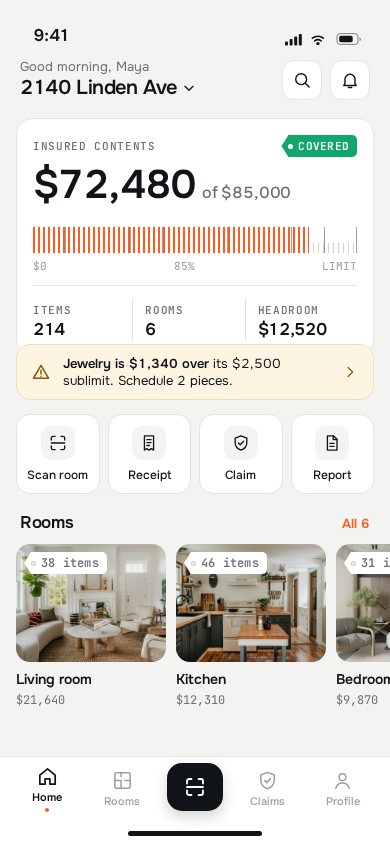
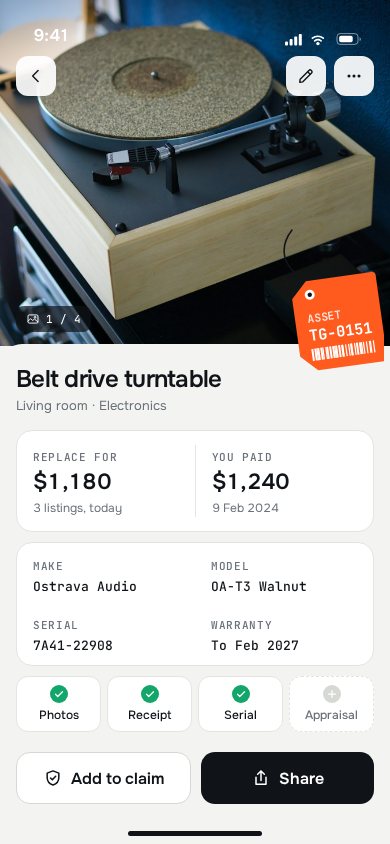
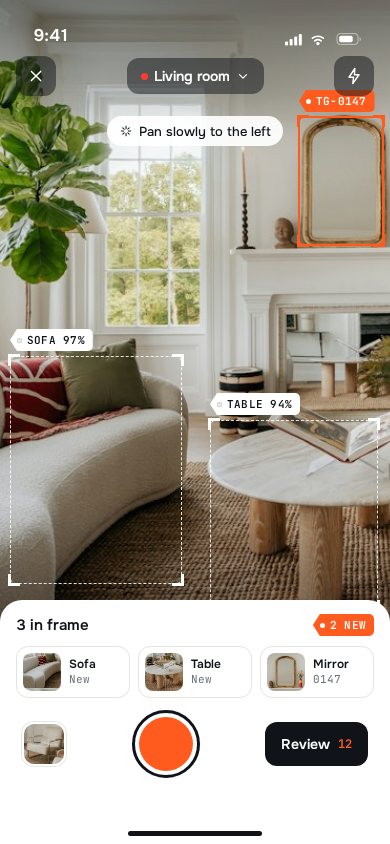
25 screens · Clinical · Light · Smart home
The Expo project
An Expo Router project on Expo SDK 58, in TypeScript. Every file name below comes from a screen in Tagged:
tagged/  # The project root
  src/
    app/  # Expo Router: one file per route
      _layout.tsx  # The stack navigator, with the fonts loaded
      index.tsx  # Opens on Welcome
      welcome.tsx  # Welcome (Onboarding)
      sign-in.tsx  # Sign in (Sign in)
      your-policy.tsx  # Your policy (Form)
      home.tsx  # Home (Home)
      rooms.tsx  # Rooms (List)
      living-room.tsx  # Living room (Detail)
      item.tsx  # Item (Detail)
      scan.tsx  # Scan (Media)
      new-item.tsx  # New item (Form)
      receipt.tsx  # Receipt (Detail)
      search.tsx  # Search (Search)
      valuables.tsx  # Valuables (List)
      coverage.tsx  # Coverage (Dashboard)
      value-history.tsx  # Value history (Dashboard)
      start-a-claim.tsx  # Start a claim (Form)
      claim-items.tsx  # Claim items (List)
      review-claim.tsx  # Review claim (Checkout)
      claim-sent.tsx  # Claim sent (Success)
      claim-status.tsx  # Claim status (Tracking)
      insurer-report.tsx  # Insurer report (Form)
      warranties.tsx  # Warranties (List)
      notifications.tsx  # Notifications (List)
      tagged-plus.tsx  # Tagged Plus (Paywall)
      profile.tsx  # Profile (Profile)
      settings.tsx  # Settings (Settings)
    components/
      icons.tsx  # Every icon the screens use, as a component
    theme/
      colors.ts  # The palette by role
  assets/images/  # The photos
  app.json  # App name, scheme and splash
  package.json  # Expo SDK 58, Expo Router, fonts from @expo-google-fonts
  README.md  # How to run it and what is where
How to run it
- Get the template. Buy Tagged (files from $10, every format included), use a free download from a paid plan, or open it with a Template Pass.
- Download and install. Download the React Native zip, unpack it and run npm install in the folder. You need Node.js 20 or newer.
- Run it. Run npx expo start, then open it in Expo Go on your phone, or press i for the iOS simulator or a for the Android emulator.
- Make it yours. Change src/theme/colors.ts to recolour every screen at once, replace the sample content in each route, and add your data and backend.
npm install
npx expo start
What works on download
- Native components. Every screen is built from React Native views, text, images and SVG icons: no web views, no screenshots.
- Navigation. Wired between screens with Expo Router, following the links in the template's prototype: buttons and tabs go where they should.
- Theme. The palette lives in src/theme/colors.ts by role, and each screen keeps plain StyleSheet styles beside it: no styling library to set up.
What is yours to wire up
- Data. Lists, prices and profiles are static sample content from the template. Swap them for your own state or API calls.
- Backend. There is no backend, sign in or payments code. Forms and buttons are interface only, ready for your logic.
- Store setup. App icon, splash screen, bundle id and store listing are yours to set in app.json before you ship.
The 25 screens
| Screen | Screen type | Route file |
|---|---|---|
| Welcome | Onboarding | src/app/welcome.tsx |
| Sign in | Sign in | src/app/sign-in.tsx |
| Your policy | Form | src/app/your-policy.tsx |
| Home | Home | src/app/home.tsx |
| Rooms | List | src/app/rooms.tsx |
| Living room | Detail | src/app/living-room.tsx |
| Item | Detail | src/app/item.tsx |
| Scan | Media | src/app/scan.tsx |
| New item | Form | src/app/new-item.tsx |
| Receipt | Detail | src/app/receipt.tsx |
| Search | Search | src/app/search.tsx |
| Valuables | List | src/app/valuables.tsx |
| Coverage | Dashboard | src/app/coverage.tsx |
| Value history | Dashboard | src/app/value-history.tsx |
| Start a claim | Form | src/app/start-a-claim.tsx |
| Claim items | List | src/app/claim-items.tsx |
| Review claim | Checkout | src/app/review-claim.tsx |
| Claim sent | Success | src/app/claim-sent.tsx |
| Claim status | Tracking | src/app/claim-status.tsx |
| Insurer report | Form | src/app/insurer-report.tsx |
| Warranties | List | src/app/warranties.tsx |
| Notifications | List | src/app/notifications.tsx |
| Tagged Plus | Paywall | src/app/tagged-plus.tsx |
| Profile | Profile | src/app/profile.tsx |
| Settings | Settings | src/app/settings.tsx |
The design
Clinical and exact, like a well kept ledger: a cool paper grey page (#f3f4f1), white cards with a 1px #e3e5e0 hairline and no shadow, ink (#101418) text and a single signal orange (#ff5b1f) for tags, the main action and the filled part of meters. Green (#12a66a) means covered or proven, amber (#e89a0c) means over a sublimit or missing a receipt, red (#e5342b) only for over limit. Labels are small uppercase JetBrains Mono with wide tracking; IDs, serials, values and dates are mono too. The signature is the asset tag: a notched label with a white eyelet and an ID like TG-0151, pinned to photos with a thin string, hung off item heroes and claims as a large orange tag with a barcode. Coverage is drawn as a tick mark ruler with orange filled ticks and a limit marker. Photos are real rooms and belongings, item thumbnails are crops of the room photo, and the floor plan is a fine ink line drawing with item dots. Type in Onest.
| Colour | Role |
|---|---|
| #f3f4f1 | background |
| #ffffff | surface |
| #101418 | text |
| #6a717a | text-muted |
| #ff5b1f | accent |
| #ffffff | accent-contrast |
| #12a66a | secondary |
| #e3e5e0 | border |
| #e5342b | danger |
Get the files
Remixing Tagged is free. To get the template itself, the files are from $10, and one price unlocks every format:
- Figma. Every screen as editable layers: named frames, text, vectors and photos, with colour and text styles.
- React Native (Expo). An Expo Router project with every screen, the navigation between them, the theme and the icons.
- SwiftUI. An Xcode project for iOS 17 with a SwiftUI view per screen, fonts and assets.
- Flutter. A Flutter app with go_router, a widget per screen, fonts and assets.
- HTML. Each screen as a standalone HTML file with its fonts and photos, plus the design tokens as CSS and JSON.
Get the Tagged files · Tagged in Figma · Tagged in React Native · Every template with a Template Pass ($49 for a year)
Tagged in other formats
- Tagged Figma template
- Tagged in SwiftUI (in the same purchase)
- Tagged in Flutter (in the same purchase)
- See every Tagged screen and remix it free
More smart home React Native templates
- Dusk: Smart home scenarios
- Lumen: Smart home energy
- Abode: Smart home devices
- Boxed: Book movers and plan moving day
- Meter: Your energy supplier account
- Couch: TV remote, casting and watchlist
- Smart home app templates
- All React Native templates
Questions people ask
- What do I need installed?
- Node.js 20 or newer and npm. To see it on a phone, install Expo Go; for simulators, Xcode (iOS, on a Mac) or Android Studio. No Expo account is needed to run it.
- Which Expo version is it?
- Expo SDK 58 (React Native 0.88, new architecture) with Expo Router, TypeScript throughout. Each screen is a route file in src/app, named after the screen.
- Does the same purchase include Figma and Swift?
- Yes. One price unlocks every format of Tagged: Figma, React Native (Expo), SwiftUI, Flutter and HTML. A Template Pass ($49 for a year) unlocks every template.
- Can I use the Tagged template commercially?
- Yes. You can build and ship commercial apps with it, for yourself or for clients, as many as you like. What you cannot do is resell or give away the template files themselves, as a template or a UI kit. The photos are free-licence stock used as placeholders: swap in your own before launch.
- Do I get updates?
- Yes, free. You buy the template, not a version: every download builds from the latest Tagged design, and your library flags a template that changed since you last downloaded it.
- Is a backend included?
- No. The download is the interface: screens, navigation, styles and assets. There is no server, database, sign in, payments or API code, and the content on each screen is static sample data for you to replace.
- What is the difference between buying and remixing?
- Remixing is free: you describe your own app and it is drawn in Tagged's design, in the DraftScreens studio. Buying gets you Tagged itself as files, from $10, in Figma, React Native (Expo), SwiftUI, Flutter and HTML.