Templates · Figma templates · Food · Tabla
Tabla Figma template: tables worth dressing for app UI kit
Tabla is a tables worth dressing for app design in a Luxury style, and its Figma file holds all 25 screens as real, editable layers: frames you can resize, text you can rewrite, and the palette and type saved as styles. A complete restaurant reservations app: welcome, sign in, account and code, taste setup, a discover home, search and filters, a restaurant page, its tasting menu, reviews and writing one, booking a date and time, choosing a table on a drawn floor plan, special requests, review and deposit, a confirmation, upcoming and past bookings, the reservation pass, saved places, a rewards dashboard with tiers and a dining year chart, a Noir membership, notifications, profile and settings. Brass gold marks whatever is chosen, booked or earned.
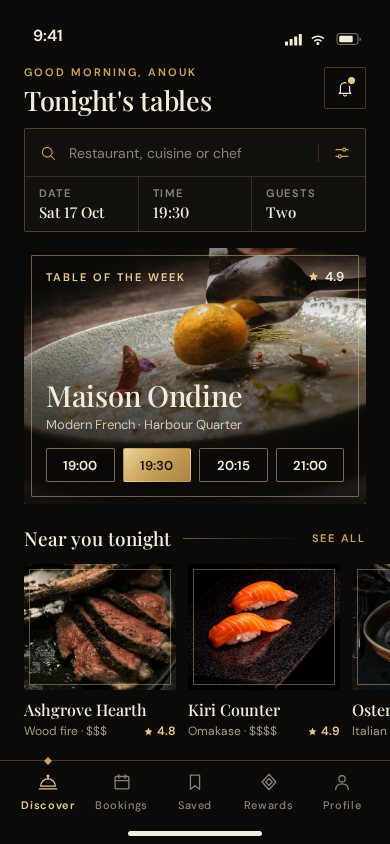
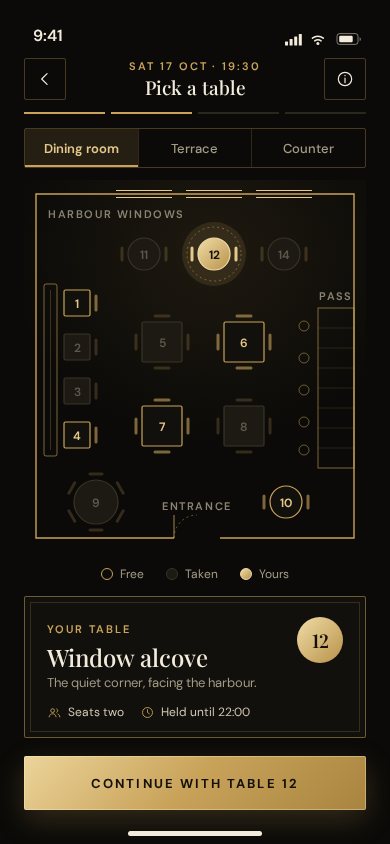
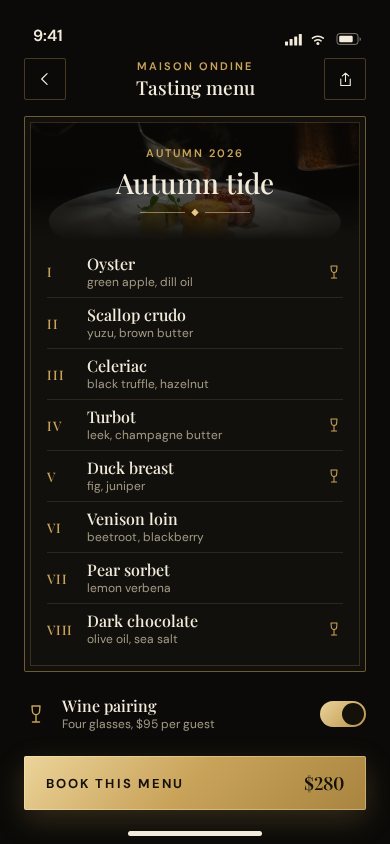
25 screens · Luxury · Dark · Food
What the Figma file contains
| Part | What you get |
|---|---|
| Frames | 25 frames at 390 by 844, one per screen, each named after its screen (Welcome, Sign in, Create account and the rest). |
| Layers | Named layers in the order they draw: containers as frames, every label as live text you can edit, nothing flattened into a picture. |
| Colour styles | 9 colour styles, one per palette role (background, surface, text, text-muted and more), with the hex values below. Created when you import with the DraftScreens plugin. |
| Text styles | Headings and body text in Playfair Display, saved as text styles on import with the plugin. |
| Photos | The template's photos as image fills, at full resolution. They are free-licence stock used as placeholders: swap in your own before launch. |
| Vectors | Icons, logos and illustrations as vector layers, so they stay sharp and take a new colour in one click. |
Colour styles
| Style | Hex |
|---|---|
| Tabla/background | #0b0a08 |
| Tabla/surface | #15130f |
| Tabla/text | #f3ecdc |
| Tabla/text-muted | #a39a86 |
| Tabla/accent | #c9a35a |
| Tabla/accent-contrast | #14110a |
| Tabla/secondary | #e6c98a |
| Tabla/border | #2c271d |
| Tabla/danger | #d9705f |
Text styles and fonts
Headings and body text: Playfair Display. A printed carte at a candlelit table: warm black backgrounds, ivory serif headlines in Playfair Display, small widely spaced uppercase labels in DM Sans, and brass gold used as line, never as flood, except on the one primary button. Cards are square cornered with a hairline gold edge, and important ones carry a second inner rule four pixels in. Photographs are dark and warm, cut square, with a fine gold frame inset. Sections are announced by a small gold lozenge between two rules. Floor plans, icons and charts are all thin gold strokes.
The 25 frames
| Frame | Screen type |
|---|---|
| Welcome | Onboarding |
| Sign in | Sign in |
| Create account | Sign in |
| Verify code | Sign in |
| Your tastes | Onboarding |
| Home | Home |
| Search | Search |
| Filters | Form |
| Restaurant | Detail |
| Tasting menu | Detail |
| Reviews | List |
| Write a review | Form |
| Book a table | Checkout |
| Pick a table | Checkout |
| Special requests | Form |
| Review booking | Checkout |
| Booking confirmed | Success |
| Bookings | List |
| Reservation | Tracking |
| Saved | List |
| Rewards | Dashboard |
| Tabla Noir | Paywall |
| Notifications | List |
| Profile | Profile |
| Settings | Settings |
How to import it into Figma
- Get the template. Buy Tabla (files from $10, every format included), use a free download from a paid plan, or open it with a Template Pass.
- Install DraftScreens for Figma. Download the plugin, then in the Figma desktop app choose Plugins, Development, Import plugin from manifest. A Figma Community listing is coming.
- Connect and import. Run the plugin, connect your DraftScreens account with a one-time code, pick Tabla and import. The frames, colour styles and text styles land in the open file.
- Or drag in the SVGs. No plugin needed: the Figma download is also a folder of SVGs, one per screen. Drag them onto the canvas and each opens as editable layers.
Get the files
Remixing Tabla is free. To get the template itself, the files are from $10, and one price unlocks every format:
- Figma. Every screen as editable layers: named frames, text, vectors and photos, with colour and text styles.
- React Native (Expo). An Expo Router project with every screen, the navigation between them, the theme and the icons.
- SwiftUI. An Xcode project for iOS 17 with a SwiftUI view per screen, fonts and assets.
- Flutter. A Flutter app with go_router, a widget per screen, fonts and assets.
- HTML. Each screen as a standalone HTML file with its fonts and photos, plus the design tokens as CSS and JSON.
Get the Tabla files · Tabla in Figma · Tabla in React Native · Every template with a Template Pass ($49 for a year)
Tabla in other formats
- Tabla React Native template
- Tabla in SwiftUI (in the same purchase)
- Tabla in Flutter (in the same purchase)
- See every Tabla screen and remix it free
More food Figma templates
- Ladle: Recipes and meal planning
- Pantry: Grocery delivery
- Brewly: Coffee ordering and loyalty
- Corked: Wine journal and cellar
- Crumb: Neighbourhood bakery
- Tiffin: Food delivery
- Food app templates
- All Figma templates
Questions people ask
- What do I need installed?
- A Figma account (the free plan works). To import with the DraftScreens for Figma plugin you need the Figma desktop app until the plugin is listed in Figma Community. Dragging in the SVGs works anywhere, including Figma in the browser.
- Is it editable, or pictures of screens?
- Editable. Text stays live text in the template's fonts, icons are vectors, containers are frames, and colours and type are saved as styles. Photos are image fills you can replace.
- Does the same purchase include code?
- Yes. One price unlocks every format of Tabla: Figma, React Native (Expo), SwiftUI, Flutter and HTML. A Template Pass ($49 for a year) unlocks every template.
- Can I use the Tabla template commercially?
- Yes. You can build and ship commercial apps with it, for yourself or for clients, as many as you like. What you cannot do is resell or give away the template files themselves, as a template or a UI kit. The photos are free-licence stock used as placeholders: swap in your own before launch.
- Do I get updates?
- Yes, free. You buy the template, not a version: every download builds from the latest Tabla design, and your library flags a template that changed since you last downloaded it.
- Is a backend included?
- No. The download is the interface: screens, navigation, styles and assets. There is no server, database, sign in, payments or API code, and the content on each screen is static sample data for you to replace.
- What is the difference between buying and remixing?
- Remixing is free: you describe your own app and it is drawn in Tabla's design, in the DraftScreens studio. Buying gets you Tabla itself as files, from $10, in Figma, React Native (Expo), SwiftUI, Flutter and HTML.