Templates · Figma templates · Education · Syntax
Syntax Figma template: learn to code app UI kit
Syntax is a learn to code app design in a Dark-first style, and its Figma file holds all 25 screens as real, editable layers: frames you can resize, text you can rewrite, and the palette and type saved as styles. A complete app for learning to code on a phone: welcome, picking a track, sign in and account creation, a home with the lesson to resume and a daily challenge, tracks, a track laid out as numbered lines, a lesson, a code editor with a key row and live output, lesson complete, challenges with test results, a streak with a contribution grid, progress charts, saved snippets, community questions and answers, a certificate, a Pro plan, notifications, profile and settings. Green means it ran or passed, amber marks where you are.
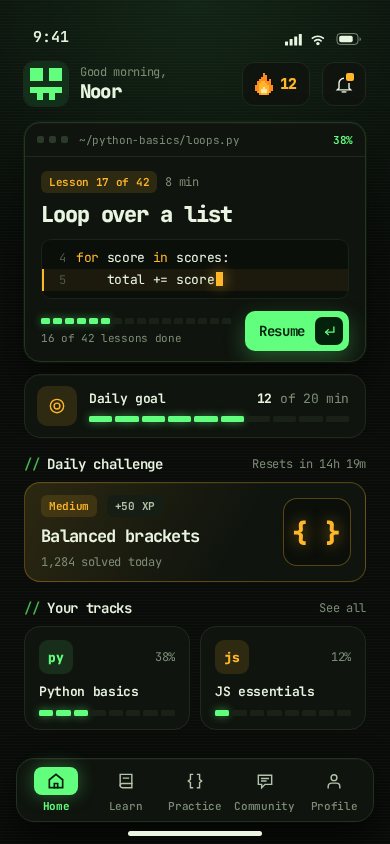
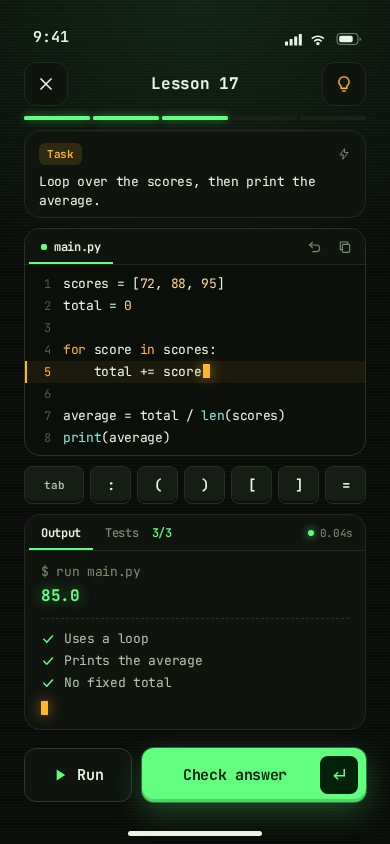
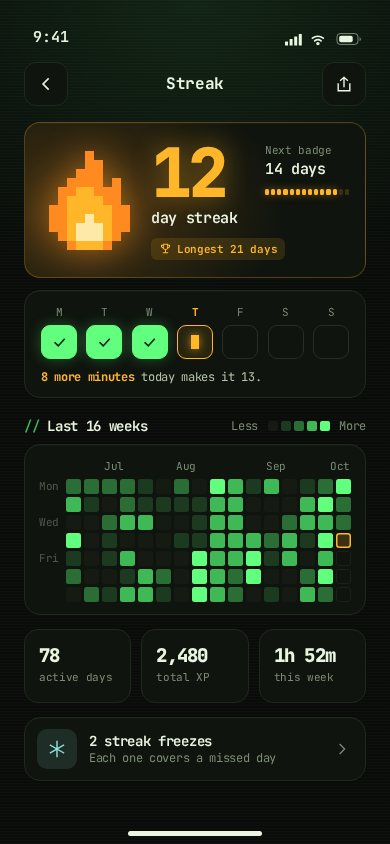
25 screens · Dark-first · Dark · Education
What the Figma file contains
| Part | What you get |
|---|---|
| Frames | 25 frames at 390 by 844, one per screen, each named after its screen (Welcome, Pick a track, Sign in and the rest). |
| Layers | Named layers in the order they draw: containers as frames, every label as live text you can edit, nothing flattened into a picture. |
| Colour styles | 9 colour styles, one per palette role (background, surface, text, text-muted and more), with the hex values below. Created when you import with the DraftScreens plugin. |
| Text styles | Headings and body text in JetBrains Mono, saved as text styles on import with the plugin. |
| Photos | The template's photos as image fills, at full resolution. They are free-licence stock used as placeholders: swap in your own before launch. |
| Vectors | Icons, logos and illustrations as vector layers, so they stay sharp and take a new colour in one click. |
Colour styles
| Style | Hex |
|---|---|
| Syntax/background | #090c09 |
| Syntax/surface | #0f140e |
| Syntax/text | #e9f5e1 |
| Syntax/text-muted | #7c8c75 |
| Syntax/accent | #62ff7e |
| Syntax/accent-contrast | #04210b |
| Syntax/secondary | #ffb629 |
| Syntax/border | #1f2a1d |
| Syntax/danger | #ff6b57 |
Text styles and fonts
Headings and body text: JetBrains Mono. A phosphor terminal, refined: a near-black background with a green tint, faint horizontal scanlines and a soft green haze at the top, slightly lighter cards with a dark green hairline. One monospaced face does everything, heavy and tightly tracked for headlines, regular for prose and code. Phosphor green glows on whatever runs, passes or is done; amber is the block cursor, keywords, the streak and the place you are now. Cards borrow from editors: a title bar with three small squares and a file path, a line number gutter, a highlighted current line. Section labels are written as comments with two green slashes. Progress is drawn as rows of small segments, never a smooth bar. Icons are thin outlines with square ends.
The 25 frames
| Frame | Screen type |
|---|---|
| Welcome | Onboarding |
| Pick a track | Onboarding |
| Sign in | Sign in |
| Create account | Sign in |
| Home | Home |
| Notifications | List |
| Tracks | List |
| Python basics | Detail |
| Lesson | Media |
| Code editor | Media |
| Lesson complete | Success |
| Challenges | List |
| Daily challenge | Detail |
| Results | Detail |
| Streak | Dashboard |
| Progress | Dashboard |
| Snippets | Search |
| Snippet | Detail |
| Community | List |
| Question | Detail |
| Ask a question | Form |
| Certificate | Detail |
| Syntax Pro | Paywall |
| Profile | Profile |
| Settings | Settings |
How to import it into Figma
- Get the template. Buy Syntax (files from $10, every format included), use a free download from a paid plan, or open it with a Template Pass.
- Install DraftScreens for Figma. Download the plugin, then in the Figma desktop app choose Plugins, Development, Import plugin from manifest. A Figma Community listing is coming.
- Connect and import. Run the plugin, connect your DraftScreens account with a one-time code, pick Syntax and import. The frames, colour styles and text styles land in the open file.
- Or drag in the SVGs. No plugin needed: the Figma download is also a folder of SVGs, one per screen. Drag them onto the canvas and each opens as editable layers.
Get the files
Remixing Syntax is free. To get the template itself, the files are from $10, and one price unlocks every format:
- Figma. Every screen as editable layers: named frames, text, vectors and photos, with colour and text styles.
- React Native (Expo). An Expo Router project with every screen, the navigation between them, the theme and the icons.
- SwiftUI. An Xcode project for iOS 17 with a SwiftUI view per screen, fonts and assets.
- Flutter. A Flutter app with go_router, a widget per screen, fonts and assets.
- HTML. Each screen as a standalone HTML file with its fonts and photos, plus the design tokens as CSS and JSON.
Get the Syntax files · Syntax in Figma · Syntax in React Native · Every template with a Template Pass ($49 for a year)
Syntax in other formats
- Syntax React Native template
- Syntax in SwiftUI (in the same purchase)
- Syntax in Flutter (in the same purchase)
- See every Syntax screen and remix it free
More education Figma templates
- Gambit: Chess training
- Buzzer: Live trivia
- Homeroom: School, all on one page
- Parla: Language learning
- Recall: Flashcards and spaced repetition
- Numo: Kids maths game
- Education app templates
- All Figma templates
Questions people ask
- What do I need installed?
- A Figma account (the free plan works). To import with the DraftScreens for Figma plugin you need the Figma desktop app until the plugin is listed in Figma Community. Dragging in the SVGs works anywhere, including Figma in the browser.
- Is it editable, or pictures of screens?
- Editable. Text stays live text in the template's fonts, icons are vectors, containers are frames, and colours and type are saved as styles. Photos are image fills you can replace.
- Does the same purchase include code?
- Yes. One price unlocks every format of Syntax: Figma, React Native (Expo), SwiftUI, Flutter and HTML. A Template Pass ($49 for a year) unlocks every template.
- Can I use the Syntax template commercially?
- Yes. You can build and ship commercial apps with it, for yourself or for clients, as many as you like. What you cannot do is resell or give away the template files themselves, as a template or a UI kit. The photos are free-licence stock used as placeholders: swap in your own before launch.
- Do I get updates?
- Yes, free. You buy the template, not a version: every download builds from the latest Syntax design, and your library flags a template that changed since you last downloaded it.
- Is a backend included?
- No. The download is the interface: screens, navigation, styles and assets. There is no server, database, sign in, payments or API code, and the content on each screen is static sample data for you to replace.
- What is the difference between buying and remixing?
- Remixing is free: you describe your own app and it is drawn in Syntax's design, in the DraftScreens studio. Buying gets you Syntax itself as files, from $10, in Figma, React Native (Expo), SwiftUI, Flutter and HTML.