Templates · React Native templates · Social · Spark
Spark React Native template: swipe dating app in Expo
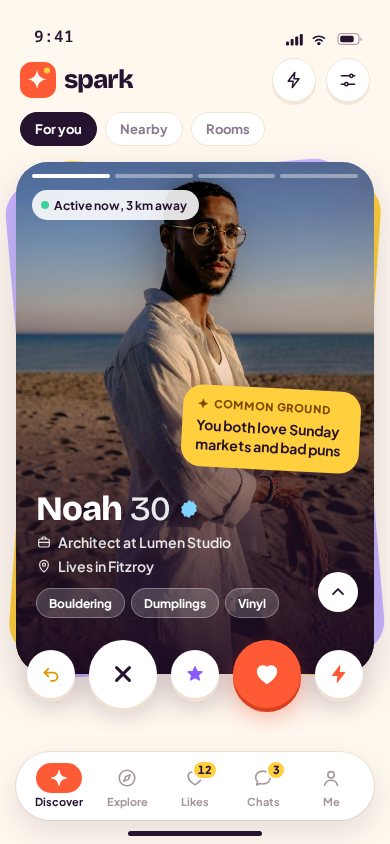
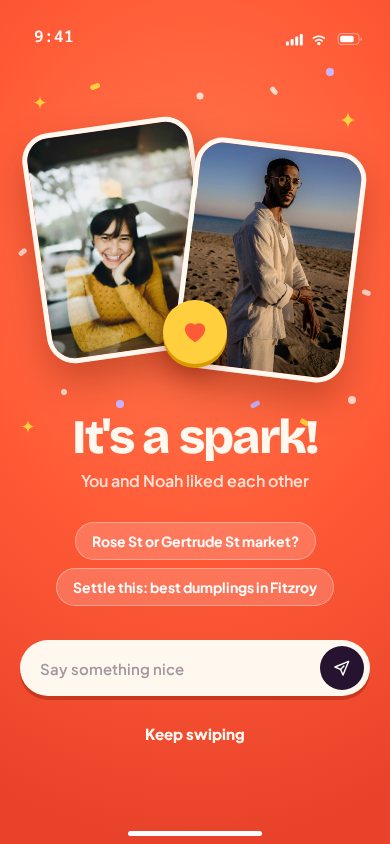
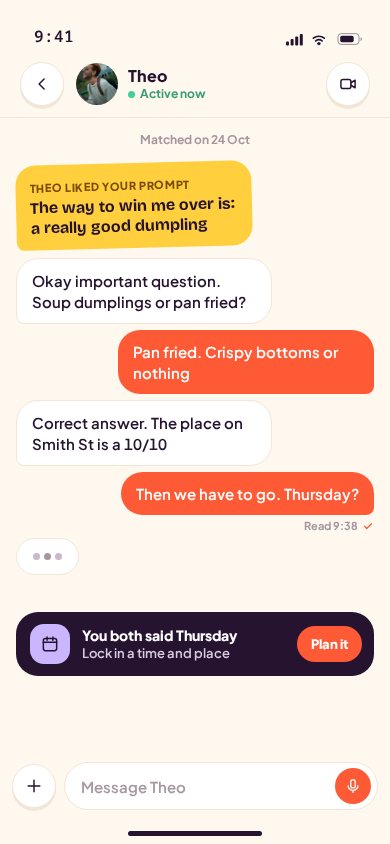
Spark is a swipe dating app design in a Playful style, and its React Native download is a working Expo project: all 25 screens as routes, linked the way the prototype is, with the palette in one colours file. A complete swipe dating app: welcome, phone sign in and code, the basics and photos, a discover deck with a common ground sticker, a full profile with prompts, filters, the match moment, likes behind a paywall, chats with new matches, a conversation that turns into a date plan, a video date with icebreakers, answering a prompt, edit profile, buying and running a Boost, booking the date and its confirmation, explore rooms, insights, notifications, a Plus plan, your profile and settings. Warm cream with tangerine, butter yellow, lilac and deep plum.
25 screens · Playful · Light · Social
The Expo project
An Expo Router project on Expo SDK 58, in TypeScript. Every file name below comes from a screen in Spark:
spark/  # The project root
  src/
    app/  # Expo Router: one file per route
      _layout.tsx  # The stack navigator, with the fonts loaded
      index.tsx  # Opens on Welcome
      welcome.tsx  # Welcome (Onboarding)
      sign-in.tsx  # Sign in (Sign in)
      verify-code.tsx  # Verify code (Sign in)
      about-you.tsx  # About you (Form)
      your-photos.tsx  # Your photos (Form)
      discover.tsx  # Discover (Home)
      profile.tsx  # Profile (Detail)
      filters.tsx  # Filters (Search)
      match.tsx  # Match (Success)
      likes.tsx  # Likes (List)
      chats.tsx  # Chats (List)
      chat.tsx  # Chat (Detail)
      video-date.tsx  # Video date (Media)
      answer-prompt.tsx  # Answer prompt (Form)
      edit-profile.tsx  # Edit profile (Form)
      boost.tsx  # Boost (Checkout)
      boost-live.tsx  # Boost live (Tracking)
      plan-a-date.tsx  # Plan a date (Checkout)
      date-set.tsx  # Date set (Success)
      explore.tsx  # Explore (Search)
      insights.tsx  # Insights (Dashboard)
      notifications.tsx  # Notifications (List)
      spark-plus.tsx  # Spark Plus (Paywall)
      me.tsx  # Me (Profile)
      settings.tsx  # Settings (Settings)
    components/
      icons.tsx  # Every icon the screens use, as a component
    theme/
      colors.ts  # The palette by role
  assets/images/  # The photos
  app.json  # App name, scheme and splash
  package.json  # Expo SDK 58, Expo Router, fonts from @expo-google-fonts
  README.md  # How to run it and what is where
How to run it
- Get the template. Buy Spark (files from $10, every format included), use a free download from a paid plan, or open it with a Template Pass.
- Download and install. Download the React Native zip, unpack it and run npm install in the folder. You need Node.js 20 or newer.
- Run it. Run npx expo start, then open it in Expo Go on your phone, or press i for the iOS simulator or a for the Android emulator.
- Make it yours. Change src/theme/colors.ts to recolour every screen at once, replace the sample content in each route, and add your data and backend.
npm install
npx expo start
What works on download
- Native components. Every screen is built from React Native views, text, images and SVG icons: no web views, no screenshots.
- Navigation. Wired between screens with Expo Router, following the links in the template's prototype: buttons and tabs go where they should.
- Theme. The palette lives in src/theme/colors.ts by role, and each screen keeps plain StyleSheet styles beside it: no styling library to set up.
What is yours to wire up
- Data. Lists, prices and profiles are static sample content from the template. Swap them for your own state or API calls.
- Backend. There is no backend, sign in or payments code. Forms and buttons are interface only, ready for your logic.
- Store setup. App icon, splash screen, bundle id and store listing are yours to set in app.json before you ship.
The 25 screens
| Screen | Screen type | Route file |
|---|---|---|
| Welcome | Onboarding | src/app/welcome.tsx |
| Sign in | Sign in | src/app/sign-in.tsx |
| Verify code | Sign in | src/app/verify-code.tsx |
| About you | Form | src/app/about-you.tsx |
| Your photos | Form | src/app/your-photos.tsx |
| Discover | Home | src/app/discover.tsx |
| Profile | Detail | src/app/profile.tsx |
| Filters | Search | src/app/filters.tsx |
| Match | Success | src/app/match.tsx |
| Likes | List | src/app/likes.tsx |
| Chats | List | src/app/chats.tsx |
| Chat | Detail | src/app/chat.tsx |
| Video date | Media | src/app/video-date.tsx |
| Answer prompt | Form | src/app/answer-prompt.tsx |
| Edit profile | Form | src/app/edit-profile.tsx |
| Boost | Checkout | src/app/boost.tsx |
| Boost live | Tracking | src/app/boost-live.tsx |
| Plan a date | Checkout | src/app/plan-a-date.tsx |
| Date set | Success | src/app/date-set.tsx |
| Explore | Search | src/app/explore.tsx |
| Insights | Dashboard | src/app/insights.tsx |
| Notifications | List | src/app/notifications.tsx |
| Spark Plus | Paywall | src/app/spark-plus.tsx |
| Me | Profile | src/app/me.tsx |
| Settings | Settings | src/app/settings.tsx |
The design
Warm, playful and tasteful: a cream page (#fff8ef), white cards with a 1.5px sand border (#f1e6d8), deep plum ink (#26132f) and one tangerine accent (#ff5a36) for likes, the active tab and the main action. Butter yellow (#ffcf3d) and lilac (#c9b6ff) are the playful second colours: the tilted cards behind the swipe deck, prompt answers drawn as sticker cards rotated 1 to 3 degrees, super sparks and Boosts. Headlines are heavy Bricolage Grotesque with tight tracking, body text is Plus Jakarta Sans. Photos are full bleed with a plum gradient at the bottom for white text. The logo is a cream four point spark on a rounded tangerine tile with a butter dot, and the same spark shape becomes confetti, badges and the Discover tab. Match and date confirmations take over the screen in tangerine or butter with confetti. Headings in Bricolage Grotesque, body text in Plus Jakarta Sans.
| Colour | Role |
|---|---|
| #fff8ef | background |
| #ffffff | surface |
| #26132f | text |
| #8a7a8f | text-muted |
| #ff5a36 | accent |
| #ffffff | accent-contrast |
| #ffcf3d | secondary |
| #f1e6d8 | border |
| #e5384f | danger |
Get the files
Remixing Spark is free. To get the template itself, the files are from $10, and one price unlocks every format:
- Figma. Every screen as editable layers: named frames, text, vectors and photos, with colour and text styles.
- React Native (Expo). An Expo Router project with every screen, the navigation between them, the theme and the icons.
- SwiftUI. An Xcode project for iOS 17 with a SwiftUI view per screen, fonts and assets.
- Flutter. A Flutter app with go_router, a widget per screen, fonts and assets.
- HTML. Each screen as a standalone HTML file with its fonts and photos, plus the design tokens as CSS and JSON.
Get the Spark files · Spark in Figma · Spark in React Native · Every template with a Template Pass ($49 for a year)
Spark in other formats
- Spark Figma template
- Spark in SwiftUI (in the same purchase)
- Spark in Flutter (in the same purchase)
- See every Spark screen and remix it free
More social React Native templates
- Ballot: Settle it on paper
- Murmur: Chat rooms for art lovers
- Wink: Video first dating
- Snoot: Social app for pets
- Huddle: Interest groups and meetups
- Glade: Photo and clip social network
- Social app templates
- All React Native templates
Questions people ask
- What do I need installed?
- Node.js 20 or newer and npm. To see it on a phone, install Expo Go; for simulators, Xcode (iOS, on a Mac) or Android Studio. No Expo account is needed to run it.
- Which Expo version is it?
- Expo SDK 58 (React Native 0.88, new architecture) with Expo Router, TypeScript throughout. Each screen is a route file in src/app, named after the screen.
- Does the same purchase include Figma and Swift?
- Yes. One price unlocks every format of Spark: Figma, React Native (Expo), SwiftUI, Flutter and HTML. A Template Pass ($49 for a year) unlocks every template.
- Can I use the Spark template commercially?
- Yes. You can build and ship commercial apps with it, for yourself or for clients, as many as you like. What you cannot do is resell or give away the template files themselves, as a template or a UI kit. The photos are free-licence stock used as placeholders: swap in your own before launch.
- Do I get updates?
- Yes, free. You buy the template, not a version: every download builds from the latest Spark design, and your library flags a template that changed since you last downloaded it.
- Is a backend included?
- No. The download is the interface: screens, navigation, styles and assets. There is no server, database, sign in, payments or API code, and the content on each screen is static sample data for you to replace.
- What is the difference between buying and remixing?
- Remixing is free: you describe your own app and it is drawn in Spark's design, in the DraftScreens studio. Buying gets you Spark itself as files, from $10, in Figma, React Native (Expo), SwiftUI, Flutter and HTML.