Templates · React Native templates · Food · Queue
Queue React Native template: join the waitlist from anywhere app in Expo
Queue is a join the waitlist from anywhere app design in a Neubrutalism style, and its React Native download is a working Expo project: all 25 screens as routes, linked the way the prototype is, with the palette in one colours file. A complete restaurant waitlist app: welcome, phone sign in and code, a nearby home with your live place and short waits, a map of wait pins, search with wait and party filters, a restaurant page with busy hours, party size, review and a joined screen, a live place in line with a countdown ring, drinks to pre-order and pay for, running late or leave the line, a table ready hold timer, wait alerts, wait trends, visit history and a visit, favourites, a host view, a Plus plan, notifications, profile and settings. Lavender and white with ink outlines, tomato, lime, yellow and sky.
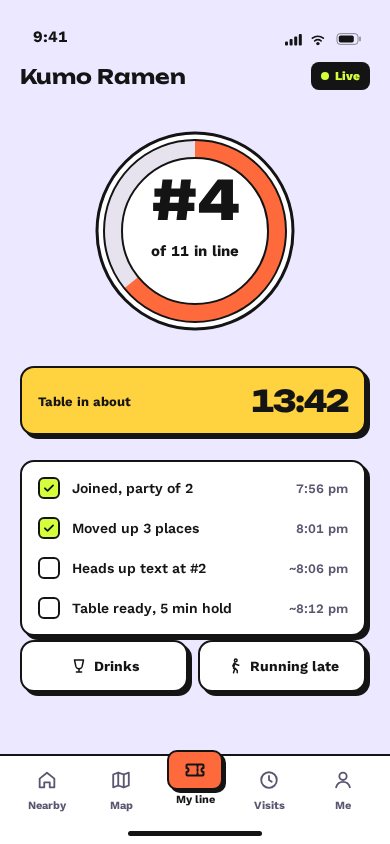
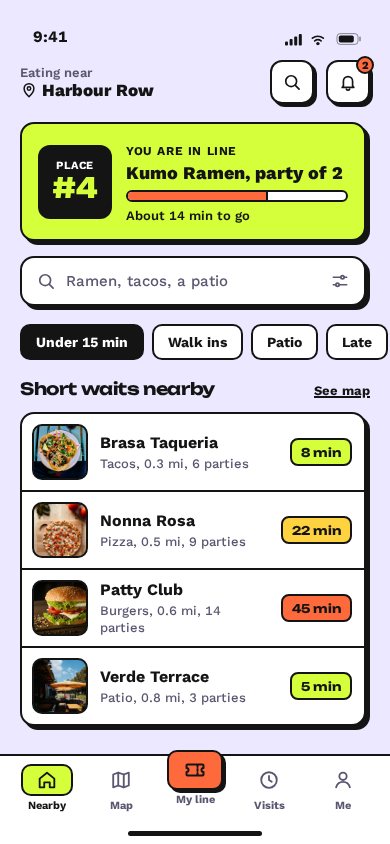
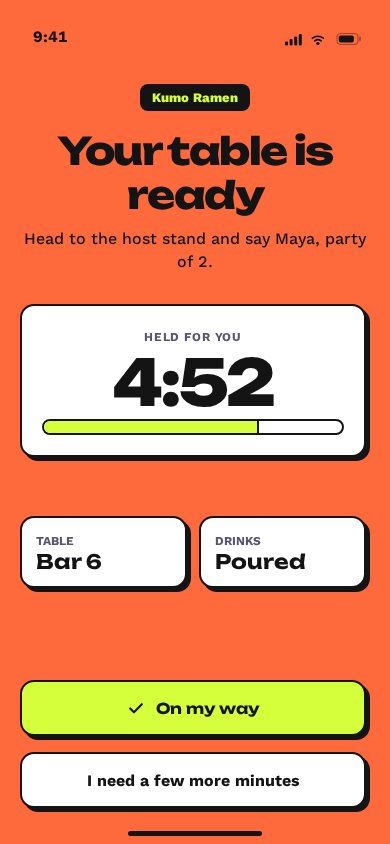
25 screens · Neubrutalism · Light · Food
The Expo project
An Expo Router project on Expo SDK 58, in TypeScript. Every file name below comes from a screen in Queue:
queue/  # The project root
  src/
    app/  # Expo Router: one file per route
      _layout.tsx  # The stack navigator, with the fonts loaded
      index.tsx  # Opens on Welcome
      welcome.tsx  # Welcome (Onboarding)
      sign-in.tsx  # Sign in (Sign in)
      verify.tsx  # Verify (Sign in)
      home.tsx  # Home (Home)
      map.tsx  # Map (Search)
      search.tsx  # Search (Search)
      spot.tsx  # Spot (Detail)
      party-size.tsx  # Party size (Form)
      review.tsx  # Review (Checkout)
      joined.tsx  # Joined (Success)
      in-line.tsx  # In line (Tracking)
      drinks.tsx  # Drinks (List)
      drink-order.tsx  # Drink order (Checkout)
      running-late.tsx  # Running late (Form)
      table-ready.tsx  # Table ready (Tracking)
      wait-alert.tsx  # Wait alert (Form)
      wait-trends.tsx  # Wait trends (Dashboard)
      visits.tsx  # Visits (List)
      visit.tsx  # Visit (Detail)
      favourites.tsx  # Favourites (List)
      host.tsx  # Host (Dashboard)
      queue-plus.tsx  # Queue Plus (Paywall)
      notifications.tsx  # Notifications (List)
      profile.tsx  # Profile (Profile)
      settings.tsx  # Settings (Settings)
    components/
      icons.tsx  # Every icon the screens use, as a component
    theme/
      colors.ts  # The palette by role
  assets/images/  # The photos
  app.json  # App name, scheme and splash
  package.json  # Expo SDK 58, Expo Router, fonts from @expo-google-fonts
  README.md  # How to run it and what is where
How to run it
- Get the template. Buy Queue (files from $10, every format included), use a free download from a paid plan, or open it with a Template Pass.
- Download and install. Download the React Native zip, unpack it and run npm install in the folder. You need Node.js 20 or newer.
- Run it. Run npx expo start, then open it in Expo Go on your phone, or press i for the iOS simulator or a for the Android emulator.
- Make it yours. Change src/theme/colors.ts to recolour every screen at once, replace the sample content in each route, and add your data and backend.
npm install
npx expo start
What works on download
- Native components. Every screen is built from React Native views, text, images and SVG icons: no web views, no screenshots.
- Navigation. Wired between screens with Expo Router, following the links in the template's prototype: buttons and tabs go where they should.
- Theme. The palette lives in src/theme/colors.ts by role, and each screen keeps plain StyleSheet styles beside it: no styling library to set up.
What is yours to wire up
- Data. Lists, prices and profiles are static sample content from the template. Swap them for your own state or API calls.
- Backend. There is no backend, sign in or payments code. Forms and buttons are interface only, ready for your logic.
- Store setup. App icon, splash screen, bundle id and store listing are yours to set in app.json before you ship.
The 25 screens
| Screen | Screen type | Route file |
|---|---|---|
| Welcome | Onboarding | src/app/welcome.tsx |
| Sign in | Sign in | src/app/sign-in.tsx |
| Verify | Sign in | src/app/verify.tsx |
| Home | Home | src/app/home.tsx |
| Map | Search | src/app/map.tsx |
| Search | Search | src/app/search.tsx |
| Spot | Detail | src/app/spot.tsx |
| Party size | Form | src/app/party-size.tsx |
| Review | Checkout | src/app/review.tsx |
| Joined | Success | src/app/joined.tsx |
| In line | Tracking | src/app/in-line.tsx |
| Drinks | List | src/app/drinks.tsx |
| Drink order | Checkout | src/app/drink-order.tsx |
| Running late | Form | src/app/running-late.tsx |
| Table ready | Tracking | src/app/table-ready.tsx |
| Wait alert | Form | src/app/wait-alert.tsx |
| Wait trends | Dashboard | src/app/wait-trends.tsx |
| Visits | List | src/app/visits.tsx |
| Visit | Detail | src/app/visit.tsx |
| Favourites | List | src/app/favourites.tsx |
| Host | Dashboard | src/app/host.tsx |
| Queue Plus | Paywall | src/app/queue-plus.tsx |
| Notifications | List | src/app/notifications.tsx |
| Profile | Profile | src/app/profile.tsx |
| Settings | Settings | src/app/settings.tsx |
The design
Neubrutalism for a busy night out: a soft lavender page (#ece8ff), white cards with a 2.5px ink (#141414) outline and a hard 4px 4px ink shadow, no blur anywhere. Unbounded carries every number that matters (place in line, minutes, prices, countdowns) in heavy weights with tight tracking; Work Sans does the reading. Wait time is always a small outlined sticker: lime under 15 minutes, yellow under 30, tomato above. Signature motif is the queue ticket: a white or lime card with round notches cut into both edges and a dashed perforation, carrying a huge #number. Full colour screens mark big moments: lime for joined, tomato for table ready, yellow for the Plus plan. Maps are flat SVG with thick outlined streets and outlined pins showing a food photo and the wait. Headings in Unbounded, body text in Work Sans.
| Colour | Role |
|---|---|
| #ece8ff | background |
| #ffffff | surface |
| #141414 | text |
| #5b5670 | text-muted |
| #ff6a3d | accent |
| #141414 | accent-contrast |
| #d4ff3a | secondary |
| #141414 | border |
| #ffd23f | warning |
| #7ad3ff | info |
| #c43414 | danger |
Get the files
Remixing Queue is free. To get the template itself, the files are from $10, and one price unlocks every format:
- Figma. Every screen as editable layers: named frames, text, vectors and photos, with colour and text styles.
- React Native (Expo). An Expo Router project with every screen, the navigation between them, the theme and the icons.
- SwiftUI. An Xcode project for iOS 17 with a SwiftUI view per screen, fonts and assets.
- Flutter. A Flutter app with go_router, a widget per screen, fonts and assets.
- HTML. Each screen as a standalone HTML file with its fonts and photos, plus the design tokens as CSS and JSON.
Get the Queue files · Queue in Figma · Queue in React Native · Every template with a Template Pass ($49 for a year)
Queue in other formats
- Queue Figma template
- Queue in SwiftUI (in the same purchase)
- Queue in Flutter (in the same purchase)
- See every Queue screen and remix it free
More food React Native templates
- Ladle: Recipes and meal planning
- Pantry: Grocery delivery
- Brewly: Coffee ordering and loyalty
- Tabla: Tables worth dressing for
- Corked: Wine journal and cellar
- Crumb: Neighbourhood bakery
- Food app templates
- All React Native templates
Questions people ask
- What do I need installed?
- Node.js 20 or newer and npm. To see it on a phone, install Expo Go; for simulators, Xcode (iOS, on a Mac) or Android Studio. No Expo account is needed to run it.
- Which Expo version is it?
- Expo SDK 58 (React Native 0.88, new architecture) with Expo Router, TypeScript throughout. Each screen is a route file in src/app, named after the screen.
- Does the same purchase include Figma and Swift?
- Yes. One price unlocks every format of Queue: Figma, React Native (Expo), SwiftUI, Flutter and HTML. A Template Pass ($49 for a year) unlocks every template.
- Can I use the Queue template commercially?
- Yes. You can build and ship commercial apps with it, for yourself or for clients, as many as you like. What you cannot do is resell or give away the template files themselves, as a template or a UI kit. The photos are free-licence stock used as placeholders: swap in your own before launch.
- Do I get updates?
- Yes, free. You buy the template, not a version: every download builds from the latest Queue design, and your library flags a template that changed since you last downloaded it.
- Is a backend included?
- No. The download is the interface: screens, navigation, styles and assets. There is no server, database, sign in, payments or API code, and the content on each screen is static sample data for you to replace.
- What is the difference between buying and remixing?
- Remixing is free: you describe your own app and it is drawn in Queue's design, in the DraftScreens studio. Buying gets you Queue itself as files, from $10, in Figma, React Native (Expo), SwiftUI, Flutter and HTML.