Templates · Figma templates · Health and fitness · Plate
Plate Figma template: calorie and macro tracker app UI kit
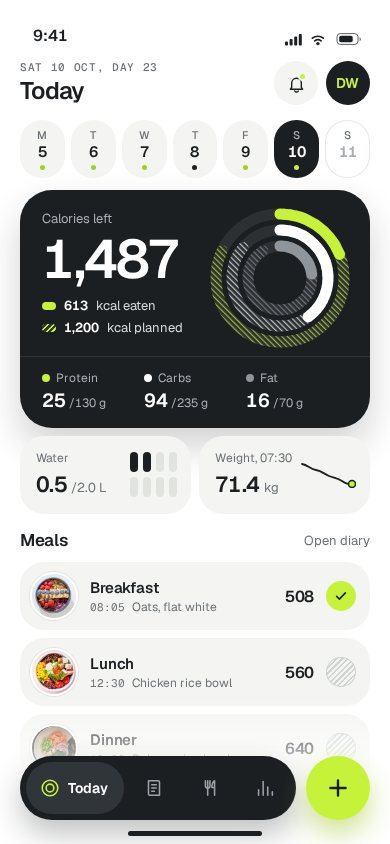
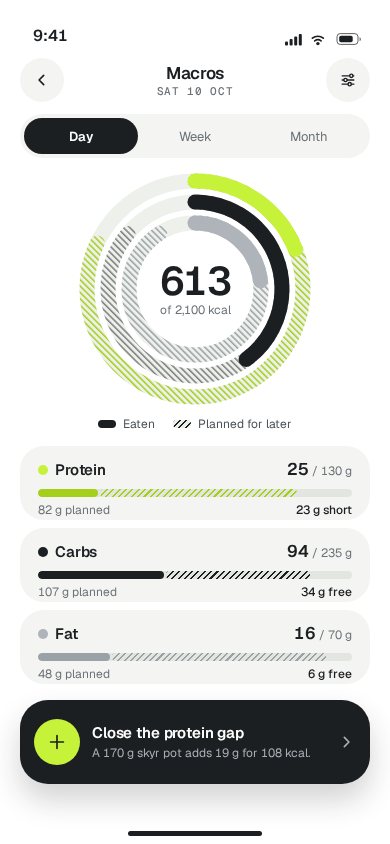
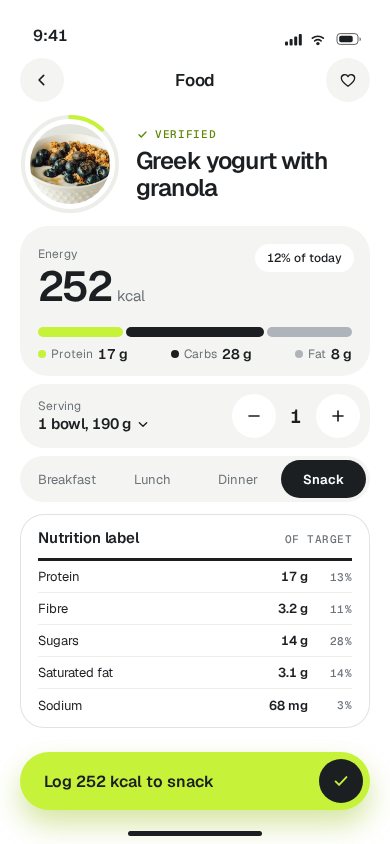
Plate is a calorie and macro tracker app design in a Clinical style, and its Figma file holds all 25 screens as real, editable layers: frames you can resize, text you can rewrite, and the palette and type saved as styles. A complete calorie and macro tracking app: welcome, sign in, goal and daily target setup, a today screen with calories eaten, planned and left, a diary by meal, food search, a food with its serving and nutrition label, barcode and photo scanning, quick add on a keypad, a meal in detail, macro rings, water, recipes, weight with a trend line, a weekly report, a Plus plan, notifications, profile and settings. Eaten is solid, planned is hatched, and every number carries its unit.
25 screens · Clinical · Light · Health and fitness
What the Figma file contains
| Part | What you get |
|---|---|
| Frames | 25 frames at 390 by 844, one per screen, each named after its screen (Welcome, Sign in, Create account and the rest). |
| Layers | Named layers in the order they draw: containers as frames, every label as live text you can edit, nothing flattened into a picture. |
| Colour styles | 9 colour styles, one per palette role (background, surface, text, text-muted and more), with the hex values below. Created when you import with the DraftScreens plugin. |
| Text styles | Headings and body text in Geist, saved as text styles on import with the plugin. |
| Photos | The template's photos as image fills, at full resolution. They are free-licence stock used as placeholders: swap in your own before launch. |
| Vectors | Icons, logos and illustrations as vector layers, so they stay sharp and take a new colour in one click. |
Colour styles
| Style | Hex |
|---|---|
| Plate/background | #ffffff |
| Plate/surface | #f4f5f2 |
| Plate/text | #1c1f22 |
| Plate/text-muted | #6c7278 |
| Plate/accent | #c7f23a |
| Plate/accent-contrast | #1c1f22 |
| Plate/secondary | #aeb4b9 |
| Plate/border | #e6e8e3 |
| Plate/danger | #e5484d |
Text styles and fonts
Headings and body text: Geist. Clinical and round: a pure white page, borderless pale grey cards, and one graphite card for the number that matters. A single lime marks protein, progress and whatever is selected; graphite is carbs and text; cool grey is fat. Everything circular is a plate: food is photographed from above and cropped to a circle with a thin white rim, and the three macros are three concentric rings. What is eaten is drawn solid and what is only planned is drawn as a fine diagonal hatch. Numbers are large Geist with tabular figures and a small grey unit after them; codes, times and label rows are small Geist Mono. Icons are thin 1.6px outlines. Thin tick rulers appear wherever a quantity is set.
The 25 frames
| Frame | Screen type |
|---|---|
| Welcome | Onboarding |
| Sign in | Sign in |
| Create account | Sign in |
| Your goal | Onboarding |
| Daily targets | Onboarding |
| Today | Home |
| Diary | List |
| Add food | Search |
| Food | Detail |
| Scan barcode | Media |
| Photo scan | Media |
| Quick add | Form |
| Meal | Detail |
| Logged | Success |
| Macros | Dashboard |
| Water | Tracking |
| Recipes | List |
| Recipe | Detail |
| Weight | Dashboard |
| Log weight | Form |
| Weekly report | Dashboard |
| Notifications | List |
| Plate Plus | Paywall |
| Profile | Profile |
| Settings | Settings |
How to import it into Figma
- Get the template. Buy Plate (files from $10, every format included), use a free download from a paid plan, or open it with a Template Pass.
- Install DraftScreens for Figma. Download the plugin, then in the Figma desktop app choose Plugins, Development, Import plugin from manifest. A Figma Community listing is coming.
- Connect and import. Run the plugin, connect your DraftScreens account with a one-time code, pick Plate and import. The frames, colour styles and text styles land in the open file.
- Or drag in the SVGs. No plugin needed: the Figma download is also a folder of SVGs, one per screen. Drag them onto the canvas and each opens as editable layers.
Get the files
Remixing Plate is free. To get the template itself, the files are from $10, and one price unlocks every format:
- Figma. Every screen as editable layers: named frames, text, vectors and photos, with colour and text styles.
- React Native (Expo). An Expo Router project with every screen, the navigation between them, the theme and the icons.
- SwiftUI. An Xcode project for iOS 17 with a SwiftUI view per screen, fonts and assets.
- Flutter. A Flutter app with go_router, a widget per screen, fonts and assets.
- HTML. Each screen as a standalone HTML file with its fonts and photos, plus the design tokens as CSS and JSON.
Get the Plate files · Plate in Figma · Plate in React Native · Every template with a Template Pass ($49 for a year)
Plate in other formats
- Plate React Native template
- Plate in SwiftUI (in the same purchase)
- Plate in Flutter (in the same purchase)
- See every Plate screen and remix it free
More health and fitness Figma templates
- Morsel: AI calorie tracker
- Dew: AI skin scan and routine
- Cradle: Baby tracker
- Medly: Doctor on call
- Donor: Blood donation, counted drop by drop
- Unfold: Yoga and stretching
- Health and fitness app templates
- All Figma templates
Questions people ask
- What do I need installed?
- A Figma account (the free plan works). To import with the DraftScreens for Figma plugin you need the Figma desktop app until the plugin is listed in Figma Community. Dragging in the SVGs works anywhere, including Figma in the browser.
- Is it editable, or pictures of screens?
- Editable. Text stays live text in the template's fonts, icons are vectors, containers are frames, and colours and type are saved as styles. Photos are image fills you can replace.
- Does the same purchase include code?
- Yes. One price unlocks every format of Plate: Figma, React Native (Expo), SwiftUI, Flutter and HTML. A Template Pass ($49 for a year) unlocks every template.
- Can I use the Plate template commercially?
- Yes. You can build and ship commercial apps with it, for yourself or for clients, as many as you like. What you cannot do is resell or give away the template files themselves, as a template or a UI kit. The photos are free-licence stock used as placeholders: swap in your own before launch.
- Do I get updates?
- Yes, free. You buy the template, not a version: every download builds from the latest Plate design, and your library flags a template that changed since you last downloaded it.
- Is a backend included?
- No. The download is the interface: screens, navigation, styles and assets. There is no server, database, sign in, payments or API code, and the content on each screen is static sample data for you to replace.
- What is the difference between buying and remixing?
- Remixing is free: you describe your own app and it is drawn in Plate's design, in the DraftScreens studio. Buying gets you Plate itself as files, from $10, in Figma, React Native (Expo), SwiftUI, Flutter and HTML.