Templates · Figma templates · Music · Hum
Hum Figma template: song recognition app UI kit
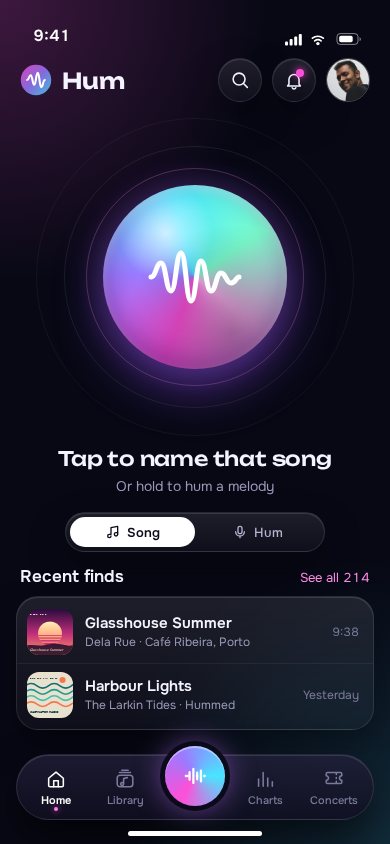
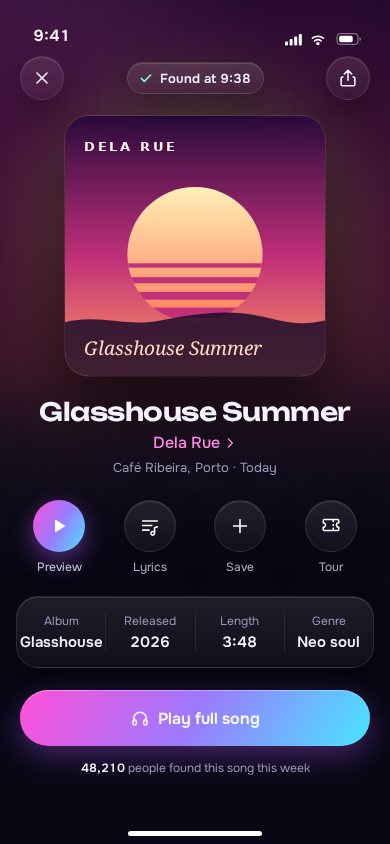
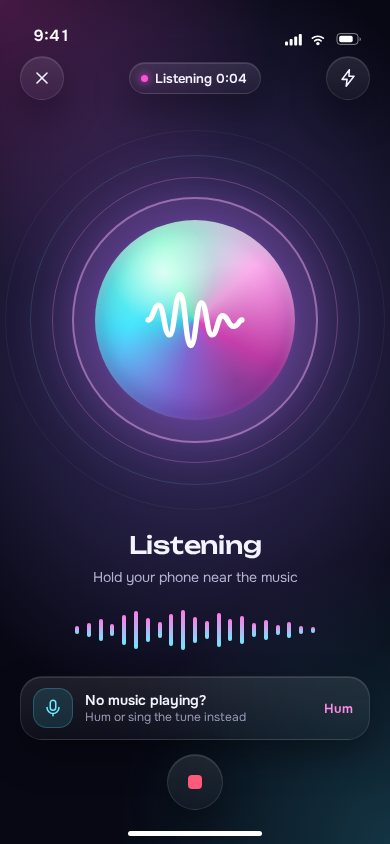
Hum is a song recognition app design in a Glass style, and its Figma file holds all 25 screens as real, editable layers: frames you can resize, text you can rewrite, and the palette and type saved as styles. A complete song recognition app: welcome, microphone access, sign in, a home with the listening orb and recent finds, listening and hum mode, the match with synced lyrics and a preview player, artist and album pages, your library of finds, search, city charts, songs found nearby on a map, your listening stats, concerts with tickets and a booking confirmation, a share card, Hum Plus, notifications, profile and settings. Ink navy glass lit by magenta and aqua.
25 screens · Glass · Dark · Music
What the Figma file contains
| Part | What you get |
|---|---|
| Frames | 25 frames at 390 by 844, one per screen, each named after its screen (Welcome, Microphone, Sign in and the rest). |
| Layers | Named layers in the order they draw: containers as frames, every label as live text you can edit, nothing flattened into a picture. |
| Colour styles | 9 colour styles, one per palette role (background, surface, text, text-muted and more), with the hex values below. Created when you import with the DraftScreens plugin. |
| Text styles | Headings in Unbounded and body text in Onest, saved as text styles on import with the plugin. |
| Photos | The template's photos as image fills, at full resolution. They are free-licence stock used as placeholders: swap in your own before launch. |
| Vectors | Icons, logos and illustrations as vector layers, so they stay sharp and take a new colour in one click. |
Colour styles
| Style | Hex |
|---|---|
| Hum/background | #070814 |
| Hum/surface | #15152a |
| Hum/text | #f4f3ff |
| Hum/text-muted | #9a98b8 |
| Hum/accent | #ff4fd8 |
| Hum/accent-contrast | #ffffff |
| Hum/secondary | #48e5ff |
| Hum/border | #26253f |
| Hum/danger | #ff5a7a |
Text styles and fonts
Headings: Unbounded. Body text: Onest. Night listening glass: an ink navy page (#070814) lit by a soft magenta glow (#ff4fd8) in the top left and an aqua glow (#48e5ff) in the bottom right, with frosted glass cards on top (white 9% to 3% gradient fill, 1px white 10% border, a 12% inner top highlight and 24px backdrop blur). The signature is the Hum orb: a glass sphere filled with a conic gradient of magenta, violet (#9b7bff), aqua and mint, a white specular highlight, a white waveform mark in the middle and two or three fine concentric ripple rings around it that widen while it listens. The same holo gradient (120deg, magenta to violet to aqua) is the accent for primary buttons, progress, gradient text on key numbers and the centre tab. Album art is original and flat (sunsets, waves, moons, flowers) on 12 to 16px tiles. Headings are in Unbounded, everything else in Onest.
The 25 frames
| Frame | Screen type |
|---|---|
| Welcome | Onboarding |
| Microphone | Onboarding |
| Sign in | Sign in |
| Home | Home |
| Listening | Media |
| Hum mode | Media |
| Match | Detail |
| Lyrics | Media |
| Player | Media |
| Artist | Profile |
| Album | Detail |
| Library | List |
| Search | Search |
| Charts | List |
| Nearby | Search |
| Stats | Dashboard |
| Concerts | List |
| Concert | Detail |
| Tickets | Checkout |
| Booked | Success |
| Share | Form |
| Hum Plus | Paywall |
| Notifications | List |
| Profile | Profile |
| Settings | Settings |
How to import it into Figma
- Get the template. Buy Hum (files from $10, every format included), use a free download from a paid plan, or open it with a Template Pass.
- Install DraftScreens for Figma. Download the plugin, then in the Figma desktop app choose Plugins, Development, Import plugin from manifest. A Figma Community listing is coming.
- Connect and import. Run the plugin, connect your DraftScreens account with a one-time code, pick Hum and import. The frames, colour styles and text styles land in the open file.
- Or drag in the SVGs. No plugin needed: the Figma download is also a folder of SVGs, one per screen. Drag them onto the canvas and each opens as editable layers.
Get the files
Remixing Hum is free. To get the template itself, the files are from $10, and one price unlocks every format:
- Figma. Every screen as editable layers: named frames, text, vectors and photos, with colour and text styles.
- React Native (Expo). An Expo Router project with every screen, the navigation between them, the theme and the icons.
- SwiftUI. An Xcode project for iOS 17 with a SwiftUI view per screen, fonts and assets.
- Flutter. A Flutter app with go_router, a widget per screen, fonts and assets.
- HTML. Each screen as a standalone HTML file with its fonts and photos, plus the design tokens as CSS and JSON.
Get the Hum files · Hum in Figma · Hum in React Native · Every template with a Template Pass ($49 for a year)
Hum in other formats
- Hum React Native template
- Hum in SwiftUI (in the same purchase)
- Hum in Flutter (in the same purchase)
- See every Hum screen and remix it free
More music Figma templates
- Quire: Sheet music and practice
- Wax: Music streaming
- Earshot: Podcast player
- Strum: Learn guitar, one chord at a time
- Gigly: Gig and festival tickets
- Padd: Beat maker
- Music app templates
- All Figma templates
Questions people ask
- What do I need installed?
- A Figma account (the free plan works). To import with the DraftScreens for Figma plugin you need the Figma desktop app until the plugin is listed in Figma Community. Dragging in the SVGs works anywhere, including Figma in the browser.
- Is it editable, or pictures of screens?
- Editable. Text stays live text in the template's fonts, icons are vectors, containers are frames, and colours and type are saved as styles. Photos are image fills you can replace.
- Does the same purchase include code?
- Yes. One price unlocks every format of Hum: Figma, React Native (Expo), SwiftUI, Flutter and HTML. A Template Pass ($49 for a year) unlocks every template.
- Can I use the Hum template commercially?
- Yes. You can build and ship commercial apps with it, for yourself or for clients, as many as you like. What you cannot do is resell or give away the template files themselves, as a template or a UI kit. The photos are free-licence stock used as placeholders: swap in your own before launch.
- Do I get updates?
- Yes, free. You buy the template, not a version: every download builds from the latest Hum design, and your library flags a template that changed since you last downloaded it.
- Is a backend included?
- No. The download is the interface: screens, navigation, styles and assets. There is no server, database, sign in, payments or API code, and the content on each screen is static sample data for you to replace.
- What is the difference between buying and remixing?
- Remixing is free: you describe your own app and it is drawn in Hum's design, in the DraftScreens studio. Buying gets you Hum itself as files, from $10, in Figma, React Native (Expo), SwiftUI, Flutter and HTML.