Templates · React Native templates · Travel · Atlas
Atlas React Native template: maps and navigation app in Expo
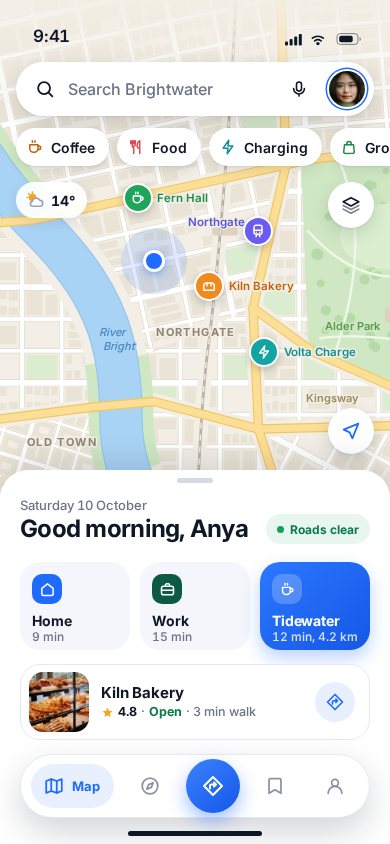
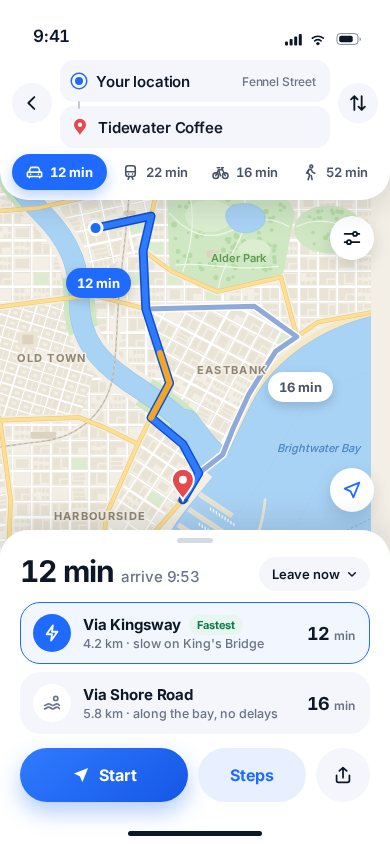
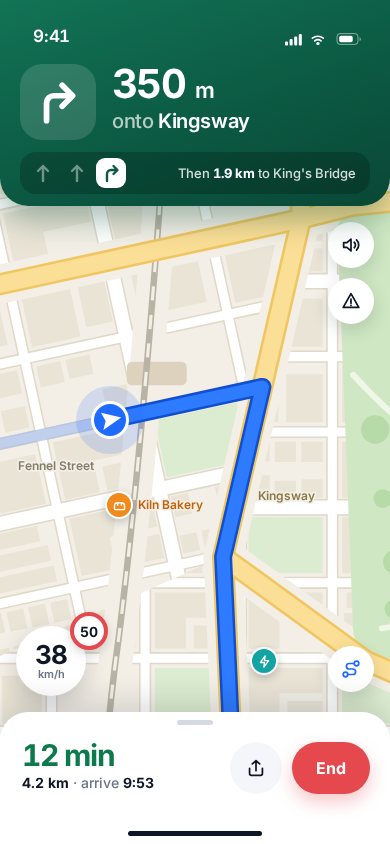
Atlas is a maps and navigation app design in a Minimal style, and its React Native download is a working Expo project: all 25 screens as routes, linked the way the prototype is, with the palette in one colours file. A complete maps and navigation app for an invented city: onboarding, location access, a full screen map with search and category chips, results, place pages with photos and reviews, directions by car, transit, bike and foot, turn by turn navigation with lane guidance, transit steps and live departures, saved lists, recents, offline areas, live location sharing, reports, profile and settings. A warm drawn map under white sheets, with one vivid blue and a deep green turn banner.
25 screens · Minimal · Light · Travel
The Expo project
An Expo Router project on Expo SDK 58, in TypeScript. Every file name below comes from a screen in Atlas:
atlas/  # The project root
  src/
    app/  # Expo Router: one file per route
      _layout.tsx  # The stack navigator, with the fonts loaded
      index.tsx  # Opens on Welcome
      welcome.tsx  # Welcome (Onboarding)
      location-access.tsx  # Location access (Onboarding)
      map.tsx  # Map (Home)
      explore-nearby.tsx  # Explore nearby (Search)
      search.tsx  # Search (Search)
      results.tsx  # Results (Search)
      place.tsx  # Place (Detail)
      reviews.tsx  # Reviews (List)
      add-a-review.tsx  # Add a review (Form)
      directions.tsx  # Directions (Detail)
      route-options.tsx  # Route options (Settings)
      navigation.tsx  # Navigation (Tracking)
      arrived.tsx  # Arrived (Success)
      transit-route.tsx  # Transit route (Detail)
      departures.tsx  # Departures (List)
      walking.tsx  # Walking (Tracking)
      saved.tsx  # Saved (List)
      list.tsx  # List (List)
      recents.tsx  # Recents (List)
      share-location.tsx  # Share location (Tracking)
      report.tsx  # Report (Form)
      offline-maps.tsx  # Offline maps (List)
      download-area.tsx  # Download area (Form)
      profile.tsx  # Profile (Profile)
      settings.tsx  # Settings (Settings)
    components/
      icons.tsx  # Every icon the screens use, as a component
    theme/
      colors.ts  # The palette by role
  assets/images/  # The photos
  app.json  # App name, scheme and splash
  package.json  # Expo SDK 58, Expo Router, fonts from @expo-google-fonts
  README.md  # How to run it and what is where
How to run it
- Get the template. Buy Atlas (files from $10, every format included), use a free download from a paid plan, or open it with a Template Pass.
- Download and install. Download the React Native zip, unpack it and run npm install in the folder. You need Node.js 20 or newer.
- Run it. Run npx expo start, then open it in Expo Go on your phone, or press i for the iOS simulator or a for the Android emulator.
- Make it yours. Change src/theme/colors.ts to recolour every screen at once, replace the sample content in each route, and add your data and backend.
npm install
npx expo start
What works on download
- Native components. Every screen is built from React Native views, text, images and SVG icons: no web views, no screenshots.
- Navigation. Wired between screens with Expo Router, following the links in the template's prototype: buttons and tabs go where they should.
- Theme. The palette lives in src/theme/colors.ts by role, and each screen keeps plain StyleSheet styles beside it: no styling library to set up.
What is yours to wire up
- Data. Lists, prices and profiles are static sample content from the template. Swap them for your own state or API calls.
- Backend. There is no backend, sign in or payments code. Forms and buttons are interface only, ready for your logic.
- Store setup. App icon, splash screen, bundle id and store listing are yours to set in app.json before you ship.
The 25 screens
| Screen | Screen type | Route file |
|---|---|---|
| Welcome | Onboarding | src/app/welcome.tsx |
| Location access | Onboarding | src/app/location-access.tsx |
| Map | Home | src/app/map.tsx |
| Explore nearby | Search | src/app/explore-nearby.tsx |
| Search | Search | src/app/search.tsx |
| Results | Search | src/app/results.tsx |
| Place | Detail | src/app/place.tsx |
| Reviews | List | src/app/reviews.tsx |
| Add a review | Form | src/app/add-a-review.tsx |
| Directions | Detail | src/app/directions.tsx |
| Route options | Settings | src/app/route-options.tsx |
| Navigation | Tracking | src/app/navigation.tsx |
| Arrived | Success | src/app/arrived.tsx |
| Transit route | Detail | src/app/transit-route.tsx |
| Departures | List | src/app/departures.tsx |
| Walking | Tracking | src/app/walking.tsx |
| Saved | List | src/app/saved.tsx |
| List | List | src/app/list.tsx |
| Recents | List | src/app/recents.tsx |
| Share location | Tracking | src/app/share-location.tsx |
| Report | Form | src/app/report.tsx |
| Offline maps | List | src/app/offline-maps.tsx |
| Download area | Form | src/app/download-area.tsx |
| Profile | Profile | src/app/profile.tsx |
| Settings | Settings | src/app/settings.tsx |
The design
The map is the app: a warm drawn city (cream land, white roads with pale casings, amber main roads, blue water, green parks, tiny building blocks) fills the screen and white sheets with 28px top corners and a grabber slide over it. One vivid blue carries routes, the position dot and primary buttons; ink text, cool grey secondary text. Floating controls are white pills and circles with soft shadows. Navigation uses a deep green banner with a large white turn arrow. Times and distances are large with tight tracking and tabular numerals. Type in Inter.
| Colour | Role |
|---|---|
| #f4f6fb | background |
| #ffffff | surface |
| #0e1726 | text |
| #6b7486 | text-muted |
| #1f6bff | accent |
| #ffffff | accent-contrast |
| #0c5a43 | secondary |
| #e6e9f0 | border |
| #e5484d | danger |
Get the files
Remixing Atlas is free. To get the template itself, the files are from $10, and one price unlocks every format:
- Figma. Every screen as editable layers: named frames, text, vectors and photos, with colour and text styles.
- React Native (Expo). An Expo Router project with every screen, the navigation between them, the theme and the icons.
- SwiftUI. An Xcode project for iOS 17 with a SwiftUI view per screen, fonts and assets.
- Flutter. A Flutter app with go_router, a widget per screen, fonts and assets.
- HTML. Each screen as a standalone HTML file with its fonts and photos, plus the design tokens as CSS and JSON.
Get the Atlas files · Atlas in Figma · Atlas in React Native · Every template with a Template Pass ($49 for a year)
Atlas in other formats
- Atlas Figma template
- Atlas in SwiftUI (in the same purchase)
- Atlas in Flutter (in the same purchase)
- See every Atlas screen and remix it free
More travel React Native templates
- Kerb: Parking that reads like a road sign
- Linea: City transit
- Hollow: Cabin and boutique stays
- Aloft: Flight tracker
- Pitch: Campsite booking and trip kit
- Hail: Ride hailing
- Travel app templates
- All React Native templates
Questions people ask
- What do I need installed?
- Node.js 20 or newer and npm. To see it on a phone, install Expo Go; for simulators, Xcode (iOS, on a Mac) or Android Studio. No Expo account is needed to run it.
- Which Expo version is it?
- Expo SDK 58 (React Native 0.88, new architecture) with Expo Router, TypeScript throughout. Each screen is a route file in src/app, named after the screen.
- Does the same purchase include Figma and Swift?
- Yes. One price unlocks every format of Atlas: Figma, React Native (Expo), SwiftUI, Flutter and HTML. A Template Pass ($49 for a year) unlocks every template.
- Can I use the Atlas template commercially?
- Yes. You can build and ship commercial apps with it, for yourself or for clients, as many as you like. What you cannot do is resell or give away the template files themselves, as a template or a UI kit. The photos are free-licence stock used as placeholders: swap in your own before launch.
- Do I get updates?
- Yes, free. You buy the template, not a version: every download builds from the latest Atlas design, and your library flags a template that changed since you last downloaded it.
- Is a backend included?
- No. The download is the interface: screens, navigation, styles and assets. There is no server, database, sign in, payments or API code, and the content on each screen is static sample data for you to replace.
- What is the difference between buying and remixing?
- Remixing is free: you describe your own app and it is drawn in Atlas's design, in the DraftScreens studio. Buying gets you Atlas itself as files, from $10, in Figma, React Native (Expo), SwiftUI, Flutter and HTML.